

Expertise in preclinical models across multiple therapeutic areas
INFLAMMATORY BOWEL DISEASES
PULMONARY INFLAMMATION
FIBROSIS
JOINT PAIN (osteoarthritis, rheumatoid arthritis)
ONCOLOGY (xenograft, syngeneic tumors, orthotopic tumors, metastatic)
NEURODEGENERATIVE DISEASES (Alzheimer's, Parkinson's, Amyotrophic Lateral Sclerosis, BBB, ...)
METABOLIC DISORDERS (hypercholesterolemia, diabetes...)
SKIN DISEASES, WOUNDS (healing)
ACUTE PAIN
DRY EYE SYNDROME
STRESS MODELS
BEHAVIORAL TESTS
PHARMACOKINETICS, BIODISTRIBUTION, ADME
ACUTE, CHRONIC TOXICOLOGY
Ex vivo analyses in histology or molecular biology (flow cytometry, qPCR, Western Blot, ELISA, ELISpot, etc.)
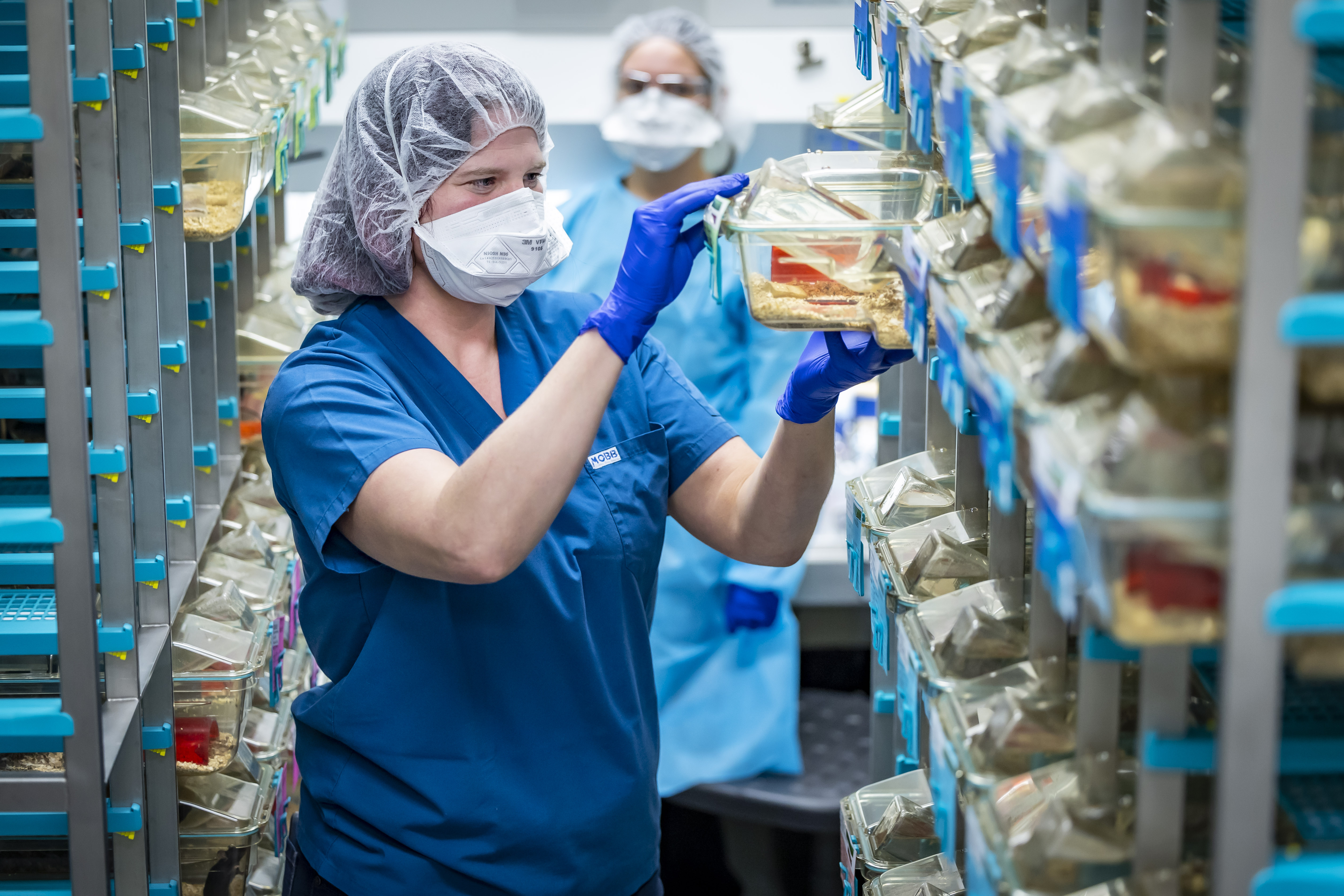
Our expertise
Validate the efficacy and safety of future therapies through personalized scientific support: adapted models, customized study design, results interpretation, advice, and recommendations.
FINANCIAL SUPPORT Available
Tax Credit for Technology Adaptation Services (Code 35)
Eligible expenses are those incurred under a contract with an eligible CCTT or an eligible CLT for the purpose of obtaining an eligible liaison and transfer service
These correspond to the total of the following amounts
- 80% of fees related to an eligible liaison and transfer service provided in Quebec by the eligible CCTT or the eligible CLT, as applicable
- participation fees for training and information activities taking place in Quebec, related to an eligible liaison and transfer service and offered by the eligible CCTT or the eligible CLT, as applicable
Only participation fees for ad hoc training activities, offered on an occasional basis and outside of a regular training program, may be considered as participation fees for the aforementioned training activities
Please note that an expense is not eligible for the tax credit for technology adaptation services if it is eligible for any of the following tax credits related to scientific research and experimental development (SR&ED)
- the tax credit for salaries – SR&ED
- the tax credit for university research or research carried out by a public research center or a research consortium
- the tax credit for pre-competitive research in private partnership
FRQ - Nature & Technologies FRQNT
Building a sustainable future is what motivates our talents working in fields as diverse as artificial intelligence, clean technologies, and climate change. At the Fonds de recherche du Québec – Nature et technologies (FRQNT), we offer them financial support while ensuring the strategic and coherent development of research in the mathematics, natural sciences, and engineering sectors.
Research and Transfer Assistance Program – PART
The Research and Transfer Assistance Program (PART) leverages the human and technological resources of college-level educational institutions (EEC) and college technology transfer centers (CCTT) to stimulate technological and social innovation in Quebec. It comprises two components:
- the Social Innovation component
- the Technological Innovation component
Application deadline for the Technological Innovation component - September 22, 2022, 4 p.m.
Please note that PART-IT projects submitted during the call for projects ending on September 22, 2022, may commence between January 2023 and August 2023
Application deadline for the Social Innovation component - October 6, 2022, 4 p.m.
Documents
Technological Innovation Stream ‒ Grants Guide 2022-2023 (PDF 703 KB)
Applied Research and Development (ARD)
Applied Research and Development (ARD) grants support projects undertaken by college researchers in partnership with private, public, or not-for-profit organizations established in Canada, while also encouraging collaboration with universities or other colleges. This funding opportunity enables the establishment and strengthening of research links and collaborations among various institutions or partners whose common objective is to create economic, social, or environmental benefits, thereby contributing to the research ecosystem continuum. The project is led by an eligible Canadian college, but the wide range of expertise expected from one or more institutions, depending on needs and available resources, can be dictated or defined according to the partners' research objectives.
Funded projects
- will provide partner organizations with access to the specific knowledge, expertise, and capabilities offered by Canadian universities and colleges
- will enable the training of students to acquire essential technical skills required by private, public, or not-for-profit organizations
- will provide economic, environmental, health, or social benefits to partner organizations and to Canada
- will allow for a wide range of collaborations between different institutions or types of partners
Support for Innovation Projects - MEIE
Eligible projects include product or process innovation projects, from the planning stage up to the pre-commercialization stage (technological showcase)
Innovation projects must meet all the following criteria
the project must
- focus on the development of a new product or process, or the significant improvement of an existing product or process
- demonstrate the necessary degree of innovation, meaning the product or process must offer a decisive advantage over existing market solutions and the targeted industry sector, both nationally and internationally
- involve technological and/or business risk or uncertainty for the company
- have required (or will require) research and development efforts
- when the product or process is intended for sale, the project must demonstrate commercial potential
Eligible projects can be carried out by
- a single company
- a group of companies
- a company or a group of companies, in collaboration with one or more public research centers in Quebec. A project is considered collaborative when a group of non-affiliated companies shares the costs, benefits, and intellectual property of the innovation project, with or without the collaboration of one or more public research centers in Quebec.
Financial Support for Technological Innovation - NRC IRAP
- If you are a Canadian small or medium-sized enterprise developing technological innovations, you may be eligible for financial assistance from NRC IRAP. We provide this funding to eligible companies through our technological innovation projects and strategic youth employment programs.
- NRC IRAP funds research and development (R&D) projects at various stages of the innovation cycle. In 2018-2019, it was mandated to expand its support to include an increased funding threshold of $10 million for larger-scale R&D projects. This enhanced financial support will enable Canadian small and medium-sized enterprises to more easily access the assistance they need to develop and grow their businesses.
- As an extension of the traditional support offered by NRC IRAP, additional funding for larger-scale R&D projects is allocated to companies that have demonstrated their capacity for rapid and substantial growth. These companies will be selected by NRC IRAP, which aims to help recipients of this increased funding threshold achieve transformative growth within 5 years of project completion, thereby making a significant contribution to Canada's economy.
Contact NRC IRAP by calling 1-877-994-4727 to find out if your company is eligible for NRC IRAP support
Interactive Visit - IRAP
- Interactive Visits are targeted, short-term interventions that can take various forms (problem investigation, literature review, proposed solution pathways, consultation). While the duration of these interventions does not permit prototyping or the development of new concepts, they can serve as a preliminary step towards the realization of an R&D project with TransBIOTech or another organization.
- Interactive Visits are a low-cost scientific and technological support program for SMEs and start-up companies, offered in collaboration with the National Research Council of Canada's (NRC) Industrial Research Assistance Program (IRAP).
- Once your project is accepted, a $250 fee is payable to TransBIOTech for file activation. Subsequently, the costs of the interactive visit are 100% covered by NRC-IRAP.
CONTACT US
In vitro, in vivo and exvivo , we perform the necessary studies and analyses to accelerate the development of your candidate towards the clinic.


